Where is the CME matching engine located?
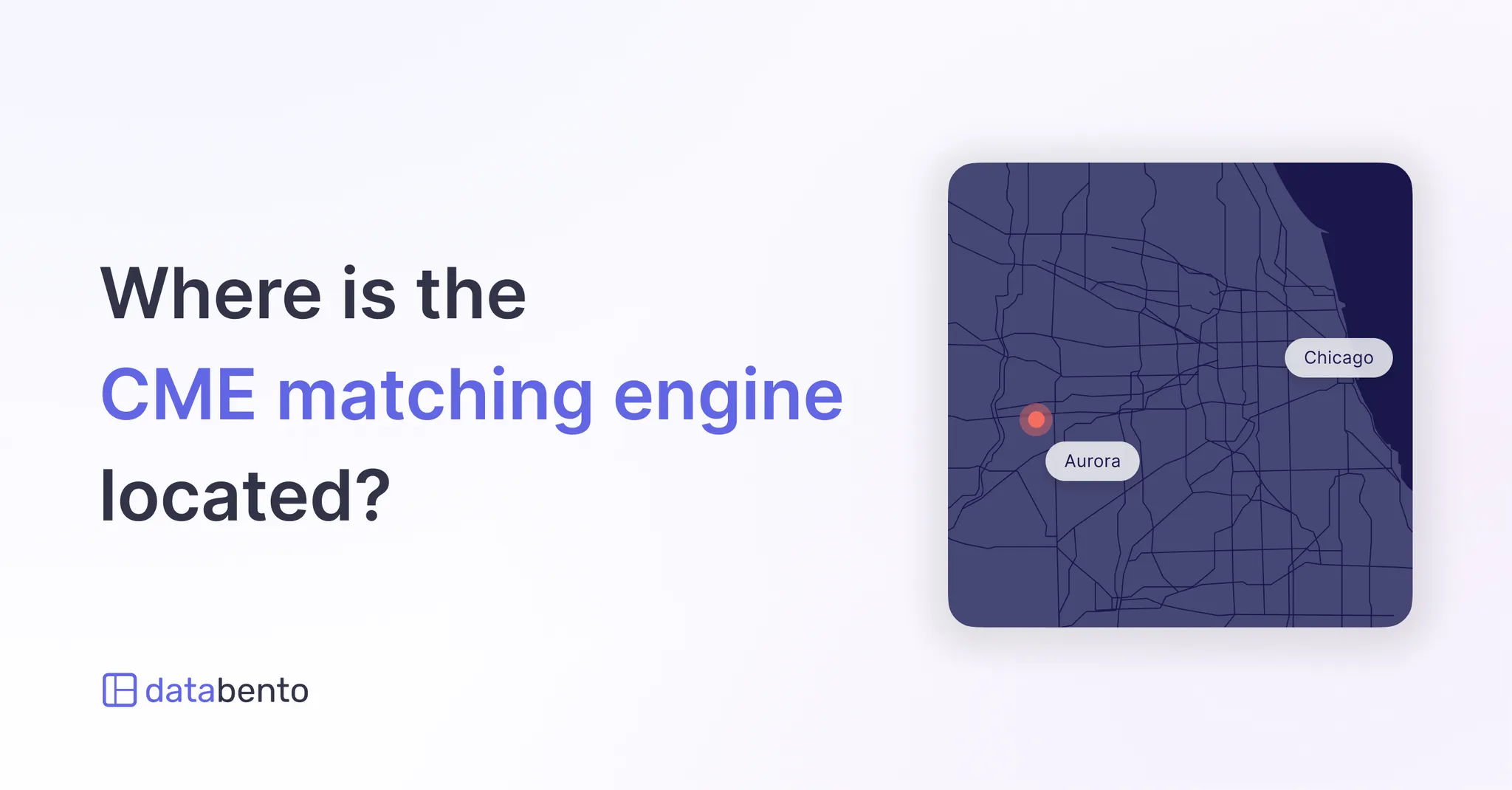
The primary matching engine for CME Group’s futures and options markets is housed in CyrusOne Aurora I, a purpose-built data center for the CME Globex electronic trading platform.
To provide the best timestamping determinism and latency, this is also where Databento's live data gateways and infrastructure for CME futures and options are located.
The facility is located at: 2905 E. Diehl Road, Aurora, IL 60502.
Although data center operators often avoid publicizing exact addresses for security reasons, the location of most commercial data centers—including Aurora I—is readily obtainable from public records, leasing documents, and industry news.
Although CME Group and its trading floor are historically associated with Chicago, its matching engine is not located in Chicago itself. CME's electronic trading infrastructure is located in Aurora, Illinois, a suburb roughly 30 miles west of downtown Chicago, near the I-88 corridor. This location has become one of the most important colocation hubs in the world for financial trading. The area provides lower real-estate costs, ample power availability, and space for large-scale infrastructure—conditions difficult to satisfy within the city.
CME Group originally operated electronic markets from facilities in the Chicago area, but as electronic trading volumes surged in the early 2000s, demand for dedicated low-latency space increased. To address this, CME established the Aurora DC3 data center as its primary matching engine site. Construction on the Aurora DC3 facility began in 2009 and CME moved into the facility in 2010.
In 2016, CME sold the building to CyrusOne, a large data center REIT, and the facility was renamed from Aurora DC3 to CyrusOne Aurora I. CME continues to lease and operate its matching-engine infrastructure from within the facility.
Over the years, Aurora has been the site of several notable events and industry developments:
The launch of Spread Networks’ low latency fiber route between the Chicago area and New Jersey catalyzed a wave of network competition across trading firms and infrastructure providers. Aurora became a focal point for the western end of these routes.
Spread Networks' fiber route quickly became obsolete for latency-sensitive trades when wireless routes began to appear. Some of the earliest microwave networks for trading were set up between CME's data center in Aurora and exchange colocation sites in New Jersey. Among these, McKay Brothers launched its microwave networks in 2012 and still holds the claim to the fastest commercial route between CME and New Jersey data centers.
As trading firms and microwave operators completed shorter microwave routes in Europe, a consortium of trading firms began to push further on longer routes, pursuing a wireless route between CME's Aurora data center and Tokyo (more specifically, Seattle, where it connects with an undersea cable landing station). The new network, called Go West, began operations in 2017.
Because roof space and line-of-sight matter enormously for microwave paths, firms engaged in disputes over roof access policies and land plots in the immediate surroundings of CME's Aurora data center. In 2018, CyrusOne finished construction of a 350 foot tower on its Aurora campus to standardize governance.
A significant outage at Aurora during Thanksgiving week in 2025 highlighted the systemic importance of the site. During the event, a total failure of cooling equipment in the data center led to a complete market halt. An event-by-event timeline and analysis of the outage, provided by Databento, can be found here.
Beyond Aurora, CME connectivity is accessible through a network of proximity hosting locations and PoPs:
CyrusOne also operates two additional data centers on its Aurora campus, adjacent to the Aurora I data center where CME's matching engine is located.
Chicago’s largest interconnection hub is ideally situated for proximity hosting for firms that do not colocate in Aurora. As a carrier hotel, it offers cross-connects to network operators such as Zayo and Lumen who provide the shortest fiber routes between Aurora and Chicago. In particular, most financial firms usually host their servers in the Equinix CH1/4/5 facilities at 350 E Cermak.
- AWS Local Zone (Chicago)
- Microsoft Azure (Northlake, IL)
- Google Cloud (Ohio region)
In 2024, CME Group and Google Cloud announced a long-term plan to build a new Google Cloud private region and colocation facility in Aurora. Over time, CME has explored hybrid models combining Aurora colocation with Google Cloud services, with the goal being to eventually migrate at least part, if not all, of its clearing, data, and supporting infrastructure to GCP. The CME Globex matching engine itself remains in Aurora as of 2026.
DC3 was the site code for the CME data center before its acquisition by CyrusOne. The site was originally known as Aurora DC3, part of CME’s private data-center naming convention. After CyrusOne purchased the building, the site was renamed Aurora I.
Some vendors, like Databento, still use DC3 for backward compatibility and version consistency. Many vendors use AUR1 to designate the CME data center.
CyrusOne itself began using CHI1, CHI2, and CHI3 as site codes for the data centers on its Aurora campus. However, many vendors still avoid using the CHI1 site code as it can be mistaken for other facilities in Chicago.
Some vendors market "Chicago-based access" to CME without specifying the exact facility. Because facilities outside Aurora are significantly cheaper, this is sometimes used to obscure material performance tradeoffs when the vendor is situated outside CME's primary colocation facility in Aurora.
When evaluating your vendor and colocation options, it's important to confirm the specific data center and network path.
Pros:
- Primary colocation site.
- Fastest possible access to CME matching engine, highest determinism and timestamp accuracy.
- Direct cross-connects to most institutional vendors offering CME data and execution services, such as Databento.
Cons:
- High cost (rack pricing often in the five-figure per month range).
- CyrusOne typically requires larger footprints (e.g., multiple cabinets) for a a direct colocation agreement, so resellers and MSPs are common for firms needing only a few servers or a single rack.
- Fewer, more expensive, WAN network carrier options.
Pros:
- Lower cost than Aurora I.
- Next highest determinism and timestamp accuracy after Aurora I.
- Next lowest latency after Aurora I (on same campus).
Cons:
- Similar downsides as Aurora I.
Pros:
- Major Internet and cloud interconnection hub.
- Easier carrier access.
- Relatively diverse selection of vendors.
- Proximity to public cloud (e.g., AWS, Google) on-ramps.
Cons:
- Higher latency (at least 287 microseconds one-way on fiber) and less timestamp determinism than AUR1.
Some examples include CoreSite CH1, Databank ORD1, Databank ORD2, Digital Realty ORD11, and Equinix CH7 Westmont.
Pros:
- Lower cost.
Cons:
- Not appropriate for latency-critical trading.
- Increased jitter and latency.
- Poor options for connecting to other services.