Upcoming changes to support 23/5 US equities trading
On Sunday, December 6, 2026, four US equity exchanges will begin trading 23 hours a day, five days a week. To support the new overnight session from 9:00 PM to 4:00 AM ET, we're making changes to five datasets across these exchanges:
- Nasdaq (
XNAS.ITCHandXNAS.BASIC) - NYSE Arca (
ARCX.PILLAR) - Cboe EDGX (
EDGX.PITCH) - MEMX (
MEMX.MEMOIR)
The exchanges have only recently provided final implementation details and test data for 23-hour trading. Based on this information, we're making the following updates to trading session coverage and historical data:
- Overnight session data
- Extended after-hours coverage
- New midnight UTC snapshots
- Nasdaq feed changes
- Historical normalization fixes
The table below summarizes which of the five datasets are affected by each change and the impact on historical data. Changes 2, 3, and 5 will apply retroactively across their full history.
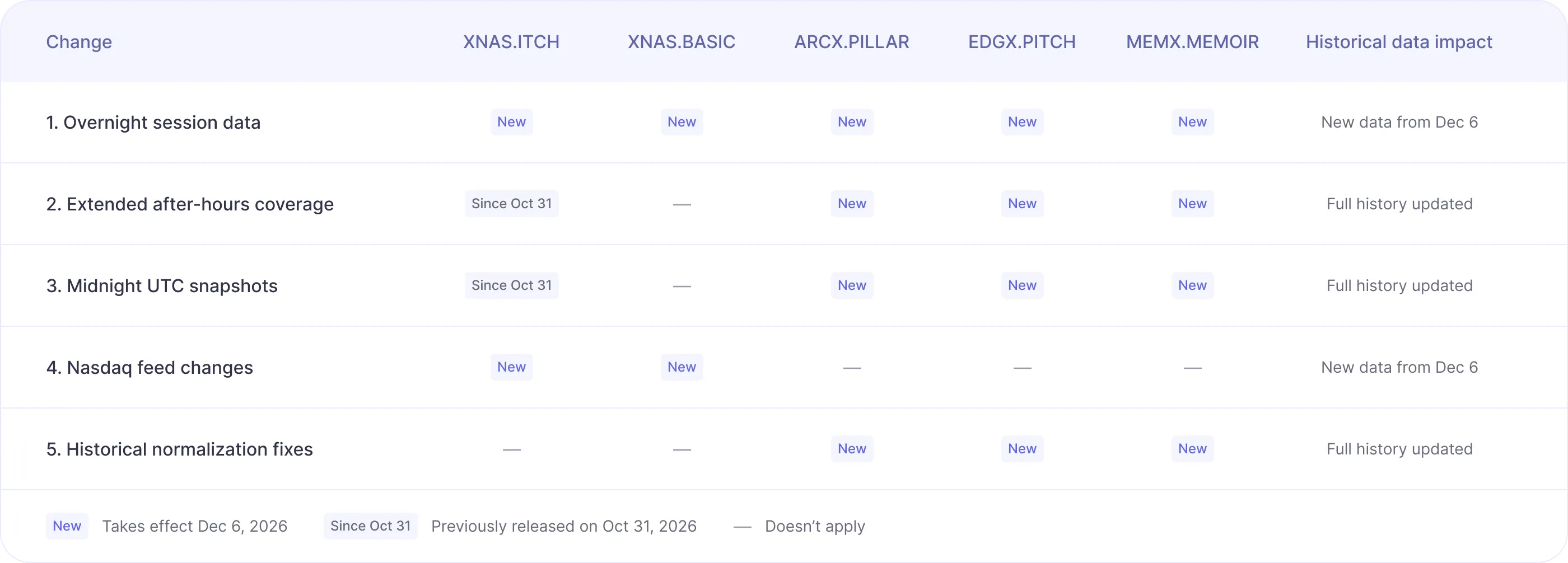
These changes may break existing integrations, particularly those that depend on trading session boundaries, raw_instrument_id values in XNAS.ITCH, or the sequence of MBP-1 records in ARCX.PILLAR.
Updated historical data for ARCX.PILLAR, EDGX.PITCH, and MEMX.MEMOIR will be available in a separate preview environment starting November 23, so you can test your integration before the December 6 production rollout.
Applies to: XNAS.ITCH, XNAS.BASIC, ARCX.PILLAR, EDGX.PITCH, and MEMX.MEMOIR
Starting December 6, these datasets will include overnight trading data from their respective exchanges. The trading week runs from Sunday at 9:00 PM to Friday at 8:00 PM ET, with a one-hour pause each weekday from 8:00 PM to 9:00 PM ET.
Our date and time conventions aren't changing and still use UTC. A venue's trading day, however, will now start on the previous calendar day in Eastern Time.
For example, the trading day for Tuesday, December 8 starts at 9:00 PM ET on Monday, December 7, and ends at 8:00 PM ET on Tuesday. In UTC, that's 2026-12-08T02:00 to 2026-12-09T01:00.
Applies to: ARCX.PILLAR, EDGX.PITCH, and MEMX.MEMOIR.
During Eastern Standard Time (EST), which runs from early November to mid-March, post-market trading ends at 8:00 PM ET (01:00 UTC the following day). Historical data for these datasets currently ends at 00:00 UTC, so the final hour of after-hours trading is missing on dates during EST.
The updated historical data includes the full post-market session. For dates during EST, data for each UTC date will begin with the final hour of the previous trading day's post-market session (00:00 to 01:00 UTC).
Because Friday's post-market session also runs past 00:00 UTC during EST, data will appear on UTC Saturdays as well.
Applies to: ARCX.PILLAR, EDGX.PITCH, and MEMX.MEMOIR.
As part of the after-hours coverage changes, updated historical data for these datasets will include snapshots at 00:00 UTC for the MBO, definition, and status schemas. Snapshots will be available Tuesday through Saturday during EST and Tuesday through Friday during Eastern Daylight Time (EDT).
For these schemas, snapshot records are returned automatically when 00:00 UTC falls within the requested time range. See our MBO snapshot documentation for an example of how these records are structured.
Applies to: XNAS.ITCH and XNAS.BASIC
On December 6, the underlying Nasdaq feeds for these datasets will change to support overnight trading:
-
XNAS.ITCHwill use Nasdaq TotalView Plus. -
XNAS.BASICwill use Nasdaq Last Sale Plus 5.0 for trades and Nasdaq Basic Plus for quotes.
Dataset IDs, schemas, publishers, and fields will remain unchanged. Although the Nasdaq TotalView Plus feed includes data from other Nasdaq-operated exchanges, XNAS.ITCH will continue to cover only The Nasdaq Stock Market.
Licensing and plan coverage will also remain unchanged. Nasdaq doesn't intend to charge additional market data fees for extended-hours data, subject to SEC approval. For more details, see Nasdaq Data News #2026-8.
Nasdaq notes that stock locate codes may differ between the overnight and day sessions. Because raw_instrument_id contains the stock locate code, we recommend using instrument_id to identify instruments instead.
Applies to: ARCX.PILLAR and MEMX.MEMOIR
We've regenerated historical data for these datasets using our current normalization, which incorporates the following fixes:
- Trades from NYSE Arca's Non-Displayed Trade and Cross Trade messages now carry the venue's TradeID or CrossID in the
order_idfield. - Breaking: Fills no longer appear as separate records in the MBP-1 schema. Where the previous normalization produced a fill record followed by a cancel record, the updated data contains only the cancel. If your application depends on the number or sequence of MBP-1 records, compare its output against the preview environment before December 6.
- Status schema
is_tradingfields are no longer set during the pre-open period before the market opens.
Updated historical data for ARCX.PILLAR, EDGX.PITCH, and MEMX.MEMOIR is available in the preview environment starting November 23.
Requests to the preview environment follow the same usage-based pricing and Databento US Equities plan coverage as the historical API.
To use it, point your historical client at the preview gateway:
import databento as db

client = db.Historical(gateway="hist-preview.databento.com")
Nasdaq datasets are excluded from the preview environment because their historical data remains unchanged in this release. These historical data updates were introduced for XNAS.ITCH on October 31, with the same changes planned for XNAS.BASIC in early 2027.
- November 23, 2026: Updated historical data for
ARCX.PILLAR,EDGX.PITCH, andMEMX.MEMOIRis available for testing in the preview environment. - December 6, 2026: 23-hour trading begins at 9:00 PM ET. Updated historical data for
ARCX.PILLAR,EDGX.PITCH, andMEMX.MEMOIRbecomes available through the historical API, and the preview environment closes.XNAS.ITCHandXNAS.BASICbegin using their new source feeds to support overnight trading.
