One API for every major index
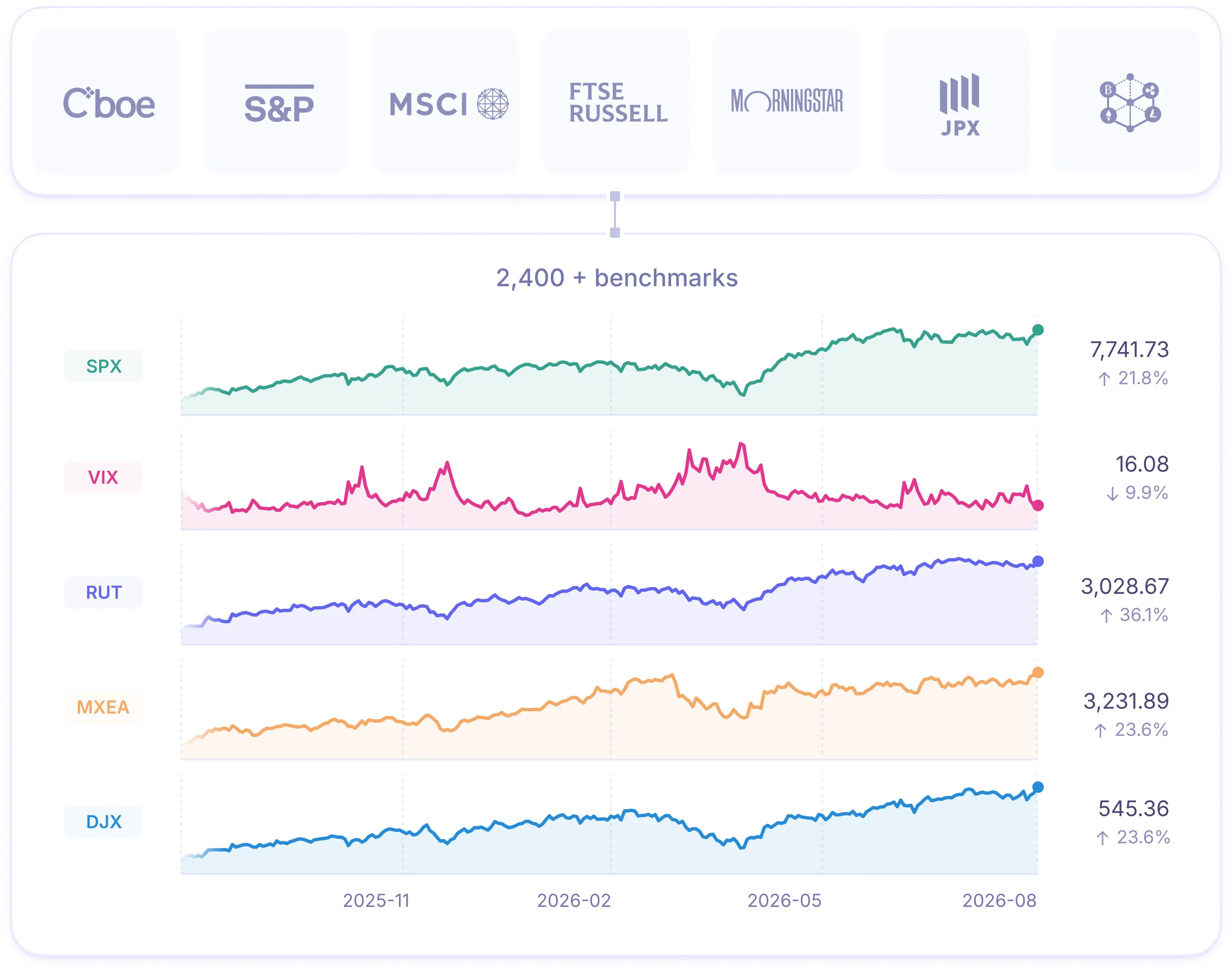
Real-time and historical index data for S&P 500 (SPX), Dow Jones (DJI), Russell 2000, FTSE 100, MSCI indices, and 2,500+ more.
Indices data, directly from the source
Our market data solutions provide 15+ normalized formats across every venue on Databento, plus raw PCAPs and dedicated connectivity options.
Market data APIs
One API for live and historical data across equities, futures, and options. Python, C++, and Rust clients included.
Flat files
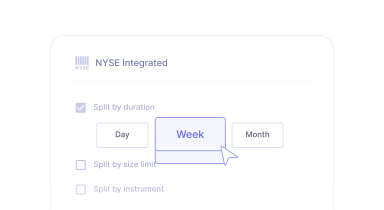
Point and click to download historical data—no code required. Export as CSV, JSON, or binary flat files.
Raw data
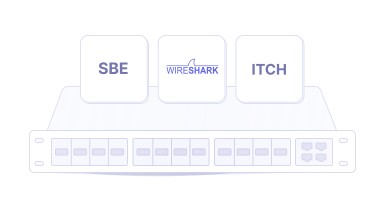
Lossless packet capture (PCAP) files in native wire format with nanosecond-resolution hardware timestamps.
2,600+ benchmarks on one platform
View dataset ->Cboe Global Indices MAIN
Flagship benchmarks
The S&P 500 (SPX) and Cboe Volatility Index (VIX), plus other volatility, settlement, and strategy indices.
SPX
VIX
XSP
DJX
MSCI
Global equity indices
Global, developed, emerging, and US equity benchmarks that underlie Cboe's US-listed MSCI index options.
MXEA
MXEF
MXWLD
MXACW
FTSE Russell
US benchmarks
The Russell 2000, Russell 1000, and Mini-Russell 2000, plus their settlement values and Cboe volatility and strategy indices.
RUT
RUI
MRUT
RVX
Cboe Global Indices CGI
Europe & volatility
Cboe UK and Europe equity benchmarks, plus gold and oil volatility, Treasury yields, and single-stock options-income indices.
BUK100P
VXN
OVX
TNX
Cboe Global Indices INAV
ETF fair values
Intraday indicative values (iNAVs) estimating the real-time fair value of nearly 300 ETFs. Most update every second.
TQQQIV
SQQQIV
UPROIV
Morningstar
Market & style
Broad market, sector, and style indices across US, developed, and emerging markets, used as benchmarks for funds and ETFs.
MSTAR
MGRO
MVAL
MWMF
CCCY
24/7 crypto indices
Cryptocurrency reference prices built on a consolidated BBO across major crypto exchanges, plus Coin Metrics and Lukka reference rates.
BTC1RP
ETH5RP
SOL100RP
JPX
Japanese benchmarks
Japan's leading equity benchmarks for Tokyo Stock Exchange stocks, including broad-market and large-cap indices.
TOPIX
TOPIX Core30
JPX Prime 150
Get started in 4 lines of code
The fastest market data integration. Build your first application and request data in under 3 minutes, in any language.
Examples
Add index data to any trading workflow
1
2
3
4
5
6
7
8
9
10
11
import databento as db
client = db.Historical("YOUR_API_KEY")

df = client.timeseries.get_range(
    dataset="DBIX.CORE",
    symbols=["SPX", "VIX"],
    schema="mbp-1",
    start="2026-03-18",
).to_df()

print(df[["symbol", "price"]])
Filter options by moneyness
Calculate moneyness across the SPXW chain and set a volatility adjusted strike range.
Implied SPX index from ES Futures curve
Estimate an S&P 500 spot proxy from the front two ES contracts.
Filter SPXW strikes by VIX-implied expected move
Interpolate the VIX to set a volatility-adjusted strike range for SPXW expirations.
Build with the
best market data API
Integrate faster with APIs that work in any language,
plus client libraries for Python, Rust, and C++.
Nanosecond-resolution timestamps
Up to four timestamps for every event, with sub-microsecond accuracy between venues.
Multiple encodings
Choose between CSV, JSON, and our highly-compressible binary encoding, DBN.
Over 19 PB of coverage
Access more than 15 years of historical and live data from over 70 venues worldwide.
Flexible pricing
Only pay for what you use, or get unlimited access with a subscription plan.
Direct from the source
Indices data sourced from the raw feed at our Equinix NY4 colocation site.
Self-service onboarding
Skip the sales call. Access your first dataset in as little as 3 minutes.
Compare data formats
Explore schemas and preview real sample files before you integrate.
Schema | Description | Sample download |
|---|---|---|
L1 Market by price (MBP-1) | Aggregated book depth with every trade and book update at the top of book (BBO). | |
L1 BBO on interval | Last best bid, best offer, and sale on 1-second or 1-minute intervals. | |
L1 Trades | Every trade event, tick-by-tick. | |
L1 OHLCV bars | Open, high, low, close prices with volume in second, minute, hour, or daily intervals. | |
L0 Instrument definitions | Properties like symbol, instrument name, expiration date, tick size, and strike price. | |
L0 Statistics | Daily instrument statistics like open interest and official settlement prices. | |
L0 Status | Trading session updates like halts, pauses, short-selling restrictions, and auction start. |
What our users are saying

Michael Tung, Investments Lead
Rick Zhan, VP Quant Research
Paul Aston, Founder

Brett Harrison, Founder

Nikita Ostroverkhov, Algo Trading
V. Chen, Equity Research Associate

Chris Pento, Co-founder and CEO
Matt Papakipos
C. Garcia, Senior Quant Researcher
Pricing
Frequently asked questions
What indices does Databento cover?
Databento Core Indices covers more than 2,500 indices, including major benchmarks such as the S&P 500 Index (SPX), Cboe Volatility Index (VIX), Russell 2000 Index (RUT), and S&P 100 Index (OEX). Coverage spans equity, volatility, options-strategy, and Treasury yield indices, as well as options settlement values, ETF intraday indicative values (iNAVs), and crypto reference prices.
Index providers include Cboe, S&P Dow Jones Indices, FTSE Russell, MSCI, Morningstar, Coin Metrics, CoinRoutes, and Lukka.
Browse the full list of indices in our data catalog.
What publishers does Databento Core Indices include?
Databento Core Indices includes all seven channels of the Cboe Global Indices Feed (CGIF), each mapped to a separate publisher. You can request indices by symbol without subscribing to individual publishers, and the publisher ID on each record identifies its source.
MAIN (
DBIX.CORE.MAIN): Major benchmarks, including the S&P 500 Index (SPX), Cboe Volatility Index (VIX), S&P 100 Index (OEX), Mini-SPX (XSP), and DJX, alongside volatility, settlement, and strategy indices. Bid and ask values are available for SPX and OEX. Settlement values include SET and VRO.MSCI (
DBIX.CORE.MSCI): MSCI global, developed, emerging, and US benchmarks.FTSE (
DBIX.CORE.FTSE): Russell 2000, Russell 1000, Mini-Russell 2000, and related Cboe strategy indices.INAV (
DBIX.CORE.INAV): Intraday indicative values (iNAVs) for nearly 300 ETFs.MSTAR (
DBIX.CORE.MSTAR): More than 1,400 Morningstar market, sector, and style indices, with daily summaries in the statistics schema.CCCY (
DBIX.CORE.CCCY): Crypto reference prices from CoinRoutes, Coin Metrics, and Lukka, published 24/7. Most include bid and ask values.CGI (
DBIX.CORE.CGI): Cboe UK and European benchmarks, gold and oil volatility indices, Treasury yields, the Cboe Nasdaq-100 Volatility Index (VXN), and options-income indices. Close values are available in the statistics schema.
What is CGIF?
The Cboe Global Indices Feed (CGIF), formerly Cboe Streaming Market Indices (CSMI), is Cboe's primary feed for real-time and end-of-day index values. It distributes indices calculated by Cboe and third-party providers, including S&P Dow Jones Indices, FTSE Russell, MSCI, and Morningstar.
Databento captures CGIF directly at Equinix NY4. See our CGIF documentation for more details.
Is there volume or order book data for indices?
No. Indices are calculated rather than traded, so there's no order book depth or trading volume.
Index-value updates appear in both the MBP-1 and trades schemas, with the index value as the price and a size of 0. As a result, OHLCV volume is always 0.
The S&P 500 Index (SPX), S&P 100 Index (OEX), and most crypto indices also have bid and ask values in the MBP-1 and BBO schemas. Close values for Cboe's European indices and daily summaries for Morningstar indices are published in the statistics schema.
What are the publishing hours for SPX, VIX, and other indices?
Publishing hours generally follow each index's underlying market. As of October 2026, typical hours are:
Cboe Volatility Index (VIX): 2:15 AM-3:15 PM Central Time (CT)
S&P 500 Index (SPX), S&P 100 Index (OEX), and DJX: 8:30 AM-3:30 PM CT
Most other US indices and intraday indicative values (iNAVs): 8:30 AM-3:00 PM CT
Cboe UK and European indices: 8:00 AM-4:30 PM London time
Morningstar indices: About 23 hours a day across Asia-Pacific, European, and US markets
Crypto indices: 24/7
Closing times can vary by a few minutes between indices. These are publishing hours for index values, not trading hours for the options and futures based on them. SPX options, for example, trade 23 hours a day, five days a week.
How frequently are index values published?
The S&P 500 Index (SPX), S&P 100 Index (OEX), most intraday indicative values (iNAVs), and crypto indices update every second. Most others, including the Cboe Volatility Index (VIX), Russell 2000 Index (RUT), and MSCI indices, update about every 15 seconds. Some indices publish only once daily.
Databento records each value sent by Cboe without repeating unchanged values. OHLCV and BBO schemas therefore contain records only for intervals with an update. For an index updating every 15 seconds, OHLCV-1s and BBO-1s records appear about every 15 seconds, while OHLCV-1m and BBO-1m records appear every minute.
To measure the update frequency of a specific index, see our indices introduction.
What is an iNAV?
An intraday indicative value (iNAV) estimates an ETF's per-share value based on the value of its underlying holdings.
Databento Core Indices provides iNAVs for nearly 300 ETFs. Most update every second between 8:30 AM and about 3:00 PM Central Time (CT). Symbols typically end in IV, such as UPROIV for the ProShares UltraPro S&P 500 ETF.
What's the difference between the SPX index, SPX options, and SPXW options?
The S&P 500 Index (SPX) is calculated by S&P Dow Jones Indices and available through Databento Core Indices. It updates every second and includes bid and ask values alongside the index value.
SPX options are cash-settled, European-style options listed on Cboe and available through our OPRA dataset. They use two symbol roots:
SPX: Standard monthly options, AM-settled to the Special Opening Quotation (SOQ). The SOQ is published in Databento Core Indices under the symbol SET.
SPXW: Weekly and daily options, including zero-days-to-expiration (0DTE), PM-settled to the SPX closing value.
What's the difference between the VIX index and VIX futures?
The Cboe Volatility Index (VIX) measures expected 30-day S&P 500 volatility, calculated from prices of near-term SPX options across multiple strikes. It's available through Databento Core Indices and updates about every 15 seconds from 2:15 AM to 3:15 PM Central Time (CT).
VIX futures (VX) and Mini VIX futures (VXM) trade on Cboe Futures Exchange (CFE) and are available through our CFE dataset. VIX options are available through our OPRA dataset.
At expiration, VIX futures and options settle to the VIX Special Opening Quotation, published separately in Databento Core Indices under the symbol VRO.
Do you cover Nasdaq or NYSE indices?
No. Our index data comes from the Cboe Global Indices Feed (CGIF), which doesn't carry proprietary Nasdaq or NYSE indices such as the Nasdaq-100 (NDX). Nasdaq and ICE, NYSE's parent company, distribute those indices through separate feeds.
We do cover the Cboe Nasdaq-100 Volatility Index (VXN). We also offer the Dow Jones Industrial Average through DJX, which represents 1/100 of its value.
You can estimate the Nasdaq-100 from E-mini Nasdaq-100 (NQ) futures. Our implied SPX example demonstrates the approach using E-mini S&P 500 (ES) futures, and the same method can apply to NQ.
How can I estimate index values when they aren't published?
Futures prices can be used to estimate an implied index level when the index itself isn't being published or isn't available in Databento Core Indices.
For example, E-mini S&P 500 (ES) futures trade nearly 24 hours a day, while S&P 500 Index (SPX) values are published from about 8:30 AM to 3:30 PM Central Time (CT). ES trades at a premium or discount to SPX based on the cost of carry, primarily interest rates and expected dividends until expiration. Adjusting for that difference provides an implied SPX level. You can use the same approach with E-mini Nasdaq-100 (NQ) futures to estimate the Nasdaq-100, which Databento Core Indices doesn't cover.
ES and NQ futures are available through our CME Globex MDP 3.0 dataset. Our implied SPX example walks through the calculation and compares the result against SPX values from Databento Core Indices.
New users get $125 in free credits
Free credit applies to all of our historical data and subscription plans.