Market order
Quick definition
A market order is an instruction to buy or sell a specified quantity of a financial instrument immediately at the best available prices, without specifying a limit price.
In a continuous limit order book, a market buy order executes against the lowest-priced resting sell orders (the best ask or best offer), while a market sell order executes against the highest-priced resting buy orders (the best bid).
If the size of a market order exceeds the available resting liquidity at the best bid or offer, it sweeps the order book, consuming liquidity at progressively less favorable price levels until the order is fully executed or no further eligible liquidity remains. Within a single matching engine, this matching process generally occurs as one uninterrupted (atomic) operation, although it may publish this event as multiple individual trades at different prices on its market data feed.
Market orders prioritize execution immediacy over price certainty. While they typically execute immediately in liquid markets, they are not guaranteed to fill completely, particularly when available liquidity is insufficient or when venue-specific price protections apply.
Market orders offer several advantages over passive limit orders, particularly for traders who prioritize immediate execution over minimizing transaction costs.
- Simpler state management. Because market orders are ordinarily executed or otherwise resolved immediately, they simplify order lifecycle management. A discretionary trader generally does not need to monitor an outstanding order or repeatedly modify its price to obtain execution. Similarly, an automated trading strategy can avoid much of the complexity associated with maintaining passive orders, including queue position and race conditions with modifying a limit order. Note however that it is still possible for a market order to result in a partial fill (if there is absolutely no liquidity on the order book to be swept within the allowable price band) or be rejected (due to reasons such as margin requirements), market orders may still require some order lifecycle management.
- Greater execution certainty and immediacy. Immediate execution is particularly valuable in fast-moving markets, where a trader may have only a short window to act on new information. An informed trader attempting to capture short-lived predictive alpha may find it unfavorable to wait for passive execution or repeatedly adjust limit prices as the market moves away. By the time a passive order fills, the information motivating the trade may already have been priced in. Market orders sacrifice price improvement in exchange for a higher probability of immediate execution.
- Immediate price impact. An aggressive market order can move the best bid or offer by consuming the available liquidity at successive price levels. This may temporarily move the quoted midprice in the direction of the trade, producing an apparent mark-to-mid gain on the newly acquired position.
- Simpler modeling. Strategies that execute aggressively are generally easier to model and backtest than strategies relying on passive limit orders. The latter require estimates of queue position and fill rate, which are difficult to simulate accurately from historical market data.
The principal disadvantage of market orders is their lack of price protection. Because a market order specifies no maximum purchase price or minimum sale price, it may experience substantial slippage when available liquidity is thin, the market is volatile, or the order is large relative to displayed depth. In the absence of exchange-imposed protections, there is no explicit limit on how far through the order book the order may execute.
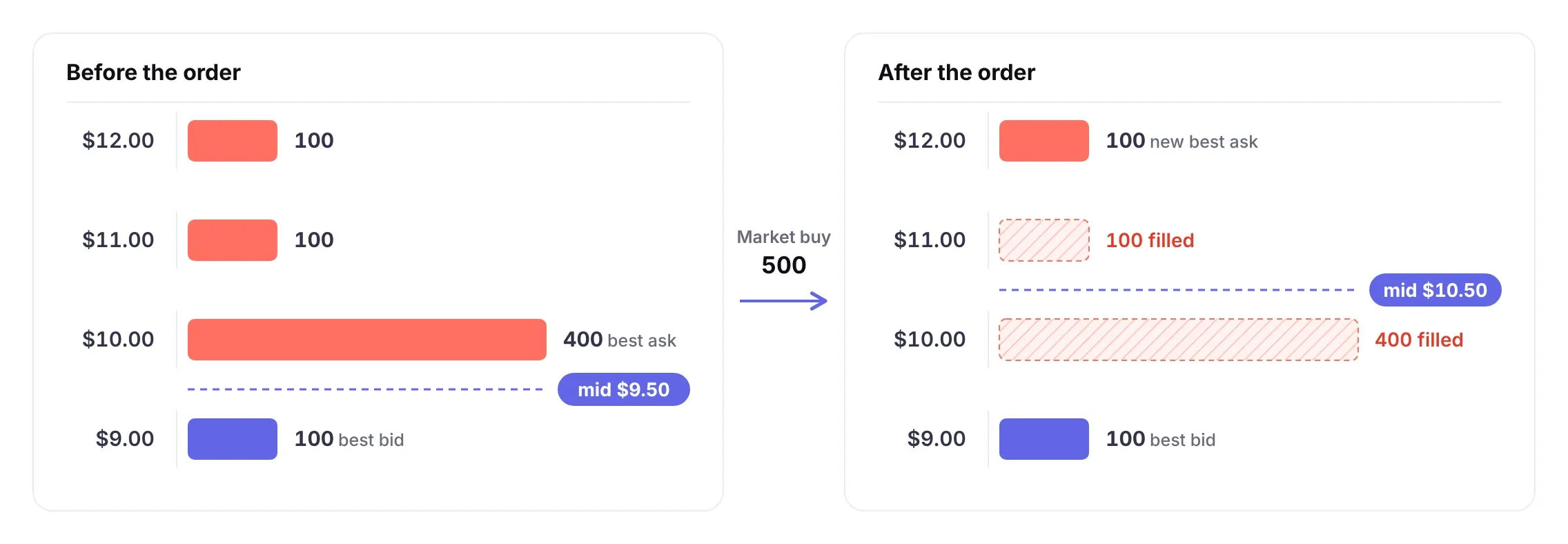
For example, suppose the order book has a best bid of 100 shares at $9.00, a best ask of 400 shares at $10.00, and additional sell orders of 100 shares at $11.00 and 100 shares at $12.00. A market buy order for 500 shares would consume the first two ask levels, resulting in an average fill price of $10.20. The new best ask would be $12.00, producing a quoted midprice of $10.50, up from $9.50.
The resulting $0.30 per-share mark-to-mid gain is not necessarily realizable: the best bid remains at $9.00, and liquidating the acquired position would require crossing the spread again. Furthermore, market impact is often transient, as liquidity providers replenish depleted price levels and quotes adjust. Without predictive alpha or a subsequent favorable price movement, mechanically moving the midprice does not by itself constitute a profitable trading strategy.
To mitigate the risk of unbounded slippage, most sophisticated traders often use marketable limit orders instead of market orders. A buy limit order is marketable when its limit price is at or above the prevailing best ask, while a sell limit order is marketable when its limit price is at or below the prevailing best bid.
By setting a sufficiently aggressive limit price, a trader can replicate much of the execution behavior of a market order while retaining explicit price protection. For example, a buy limit order priced well above the best ask may sweep multiple price levels, but it cannot execute above its specified limit price.
When combined with an immediate-or-cancel (IOC) instruction, a marketable limit order executes against available liquidity up to its limit price and cancels any unfilled remainder. This prevents the residual quantity from resting passively in the order book.
Since market orders are simpler to use than limit orders, they tend to be favored by retail investors and execution algorithms that have limited short-term predictive alpha and are more concerned with executing promptly at prices close to their targets.
Another conventional reason to prefer market orders is that passive limit orders are exposed to asymmetric adverse selection: they are more likely to be filled when the market moves against the order, such as during a price dislocation or an aggressive sweep of the order book.
A uncommon edge case arises in trading environments or markets (such as Coinbase) where it is possible to distinguish between market orders and marketable limit orders. Since market orders are often associated with less sophisticated traders who prioritize immediacy and simplicity, their use could signal to counterparties that the aggressor is less sophisticated, potentially exposing the trader to signaling risk or adverse selection.
SEC Rule 605 requires market centers and certain broker-dealers to publish monthly execution quality reports, distinguishing between market orders, marketable limit orders, and non-marketable limit orders. These reports disclose execution rates, execution speed, price improvement, and effective and realized spreads. The rule was substantially amended in 2024, with expanded reporting requirements taking effect in 2026.
According to the SEC's analysis of order flow in Q1 2023, market orders accounted for 28.1% of eligible share volume submitted to wholesalers, compared with 26.9% for marketable limit orders. On exchanges and alternative trading systems, however, market orders accounted for less than 0.01%, compared with 10.3% for marketable limit orders. The SEC also found considerable differences in fill rates and execution costs between order types and venues.
References
-
Harris, L.. (2003) Trading and Exchanges: Market Microstructure for Practitioners. Oxford University Press.
-
Anand, A., Samadi, M., Sokobin, J., and Venkataraman, K.. (2026) "Retail limit orders." Review of Finance.
Unlock market data today with $125 in free credits
Get raw market data with packet capture (PCAP) files
Unlock reference data across global markets
Free credit applies to all of our historical data and subscription plans.